MYP Tutors in Delhi — One-on-One Live Online Help for Every Subject
We provide personalised online tutoring for IB Middle Years Programme students across Delhi NCR. Our experienced MYP mentors work one-on-one with each learner to build conceptual clarity, exam confidence, and subject mastery.
Math, Science, English, French, Spanish, and Personal Project support — all from the comfort of your home.
📅 Book Your Free Demo
Experience our teaching approach with a free 30-minute online demo session.
✅ No obligation. Just results. We’ll reach out within 24 hours.
When the MYP Feels Like a Mountain
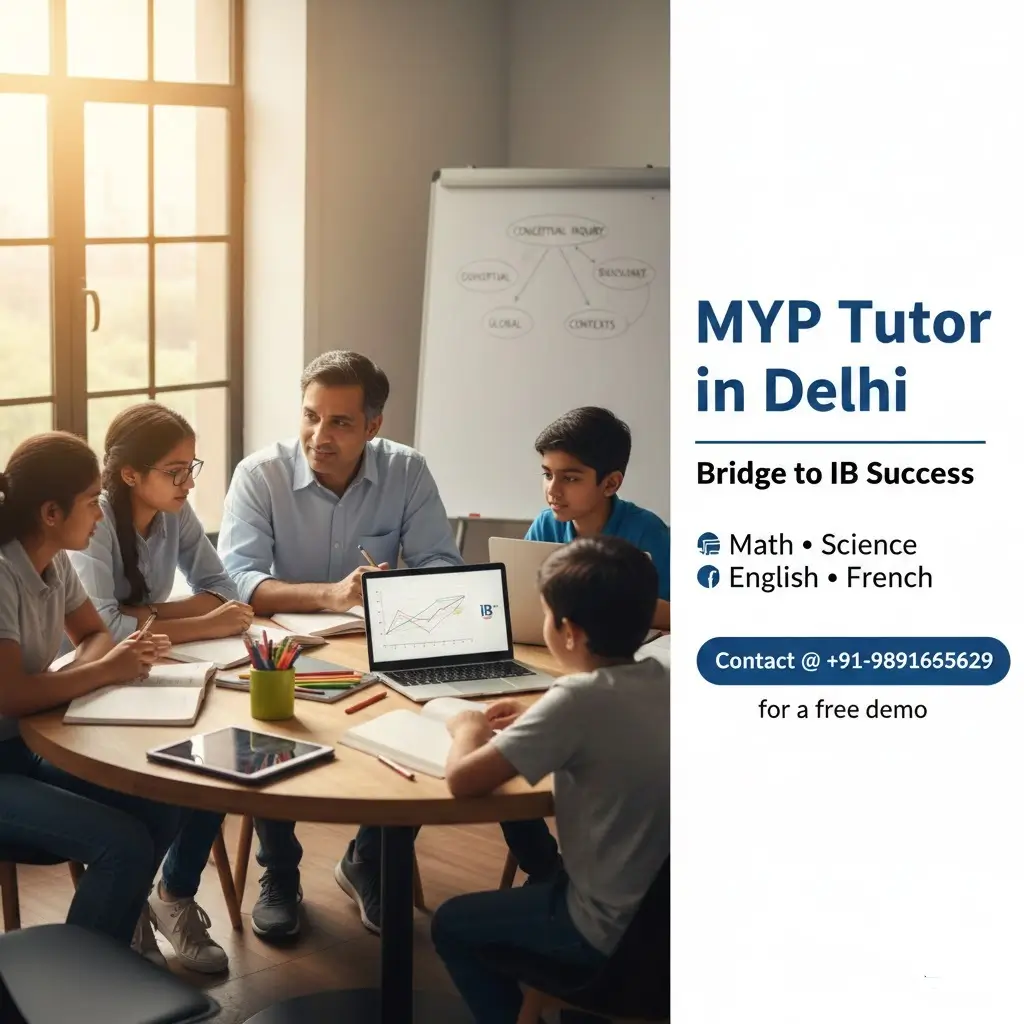
Time and again, a parent from Vasant Kunj, Saket, or Gurgaon contacts us in distress. The pattern rarely changes. Their child was a high achiever in Grade 5, but somewhere in the middle of the IB Middle Years Programme, the confidence vanished. Algebra looks unfamiliar. The Personal Project feels impossible.
We reassure every family the same way: your child has not lost their intelligence. They have stepped into a system that measures intelligence differently.
The MYP is built on conceptual understanding, global contexts, and criterion-based assessment — not textbook memorisation. In Delhi, where traditional coaching often means rote practice, finding a mentor who genuinely understands the IB philosophy decides whether a student merely copes or actually thrives. Our aim is not only eAssessment readiness. It is preparing your child for life.
Why Parents Choose Our MYP Tutors in Delhi
When we bring an educator into MyP Tutoring Academy, qualifications are only part of the picture. We look for the ability to reach a student who cannot yet see the “why” behind the “what”.
Conceptual Inquiry, Not Rote Learning
We rarely stop at solving for x. We ask what x actually represents in a real-world model. Every session follows the MYP inquiry cycle — Inquire, Act, Reflect.
Criterion-Based Mastery
MYP assessment is criterion-based. We coach students on the descriptors for Criteria A, B, C, and D, and show them that a “7” reflects depth of thought, not flawlessness.
The “Delhi Context” Advantage
We know the local IB landscape — Pathways, TSRS, GD Goenka, Step by Step, DPS International, and other Delhi NCR schools. We understand their internal deadlines and rubric interpretations.
Personalised Mentorship
Every learner absorbs ideas differently. Some need to spot the pattern first, some need to talk it out, some need to write before it clicks. We adapt the pace, examples, and feedback to the student — never the reverse.
Fully Online, One-on-One
Every session is a live, private online class. No travel, no group distractions — just focused time between your child and a subject specialist.
Progress You Can Track
Parents receive regular updates on concept mastery, confidence, and criterion-wise growth. We discuss progress through scheduled online parent-teacher meetings.
MYP Math Tutor in Delhi: Bridging the Gap to DP
MYP Math is usually where “math phobia” takes root. Moving from numerical calculations to abstract inquiry can feel abrupt and unsettling.
Case One: The Matter of “Numerical” Rohan. Rohan was a Grade 9 student at a leading IB school in Chanakyapuri. He could perform mental arithmetic effortlessly, yet he would freeze the moment a Criterion B task — Investigating Patterns — appeared. His constant plea was, “Just give me the formula!”
Our MYP Math tutors worked with him online, not by piling on more worksheets, but by training him to notice the pattern first. Three weeks were spent on what we call “investigative flow” — learning how to document trial and error properly. By Grade 10, he was not only solving equations but anticipating them. That is the foundation IB Math AA or AI demands later.
Our MYP Math tutors focus on:
- Criterion A: Knowledge and Understanding — selecting and applying mathematics in both familiar and unfamiliar situations.
- Criterion B: Investigating Patterns — the area where students struggle most. We teach them to express a general rule as a formula.
- Criterion C: Communication — using correct mathematical notation. A right answer alone is not enough; you must explain it.
- Criterion D: Real-life Application — judging whether a mathematical solution holds up in the real world.
MYP Science Tutor in Delhi: From Labs to Life
Science in the MYP is far more than Biology, Chemistry, and Physics. It is fundamentally about Scientific Inquiry.
Case Two: Myra’s Lab Reports. Myra understood the laws of physics perfectly. Her lab reports, however, were chaotic. Data was disorganised, and her “Analysis” section read like a list of unrelated facts.
Our science tutoring is not limited to explaining the Doppler Effect. It teaches a student like Myra how to structure a Scientific Investigation. We rely on digital tools and visual organisers so students can see the thread connecting hypothesis to conclusion.
Whether your child studies Integrated Science or the Discrete Sciences, we make sure they grasp the Global Context — how science shapes the environment, ethics, and economy. We do not merely teach the “Atom”. We teach the “Ethics of Nuclear Energy”.
MYP English Tutor in Delhi: Finding a Voice
In the MYP, English is “Language and Literature”. It demands a degree of critical analysis that many 13-year-olds find intimidating.
Many students we meet in Delhi speak fluent English yet struggle with Criterion B: Comprehending Context. They read the words but miss the subtext — the irony, the cultural nuance, the author’s intent.
Case Three: Ananya’s Comparative Essay. Ananya had shifted from a different curriculum midway through Grade 8. She felt behind because she had never learned to write a comparative essay using the TEEL structure. Our approach with her was visual storytelling. We mapped out themes with colours and symbols long before a single paragraph was written.
Our English tutors focus on:
- Analysing diverse texts — from Shakespeare to contemporary graphic novels.
- Creative Writing — helping students find their own style while staying within the rubric.
- Oral Presentations — building the confidence to speak before an audience, a skill essential for the IB Diploma.
MYP French Tutor in Delhi: Beyond the Vocabulary
French, or Language Acquisition, is often the subject that causes the most homework headaches. The reason is simple: it is usually taught as a list of verbs to conjugate.
In the MYP, the objective is communicative competence. We have met students who can conjugate every “ir” verb but cannot order a meal in a role-play scenario.
Our MYP French tutors in Delhi work across Phases 1–6 of language acquisition. We use immersive techniques that make French a living language. We discuss Francophone cultures in Africa and Canada, not just Paris.
The “Mountain” of MYP: Navigating the Personal Project
The Personal Project is the capstone of the MYP. For many Delhi students, it is the first time they must manage a long-term project independently.
Case Four: Kabir’s Drone. Kabir wanted to build a drone from scratch. He had the technical skill but no idea how to maintain the Process Journal. He was doing the work yet failing the “Reflection” component of the IB.
This is where a mentor becomes crucial. We helped Kabir break his “Mountain” into small, manageable hills:
- Defining a Goal: Making it SMART — Specific, Measurable, Achievable, Relevant, Time-bound.
- The Report: Aligning his journey with the three pillars — Investigating, Planning, and Taking Action.
- The Reflection: Helping him understand that the product matters less than what he learned about himself as a learner.
How We Personalise MYP Tutoring in Delhi
Every journey begins with a diagnostic. We assess how your child thinks, writes, and solves problems, then adjust the pace, examples, and feedback to suit them — all through live online sessions.
- For students who focus better in short bursts, we run micro-sessions with brief reflection breaks.
- For abstract concepts, we turn equations into shapes using Desmos and GeoGebra.
- For exam preparation, we conduct low-stakes mock exams focused on strategy, command terms, and timing — not just the score.
- We discuss your child’s progress with you through online parent-teacher meetings and, when needed, coordinate with the school’s learning support team.
The aim is simple: your child should feel understood — never labelled.
The Transition: From Grade 10 MYP to the DP
The most critical stretch for any IB student is the six months between the end of Grade 10 and the start of Grade 11.
This is where our expertise as IB Math AA/AI specialists comes in. Many students pick DP subjects simply because their friends did. We use this window to run “Diagnostic Deep Dives”.
If a student struggles with the abstract nature of MYP Criterion B, we may guide them toward Math AI (Applications and Interpretation) in the DP. If they love the “pure math” puzzles, Math AA (Analysis and Approaches) is where they belong.
We do not tutor only for the current grade. We tutor for the future. MYP 5 students are prepared for DP rigour by introducing DP-style questions early, so the “jump” in difficulty never feels like a cliff.
Why Your Child Needs a Thought Partner
Students in Delhi live under enormous pressure. Competition is fierce, and distractions — from social media to social expectation — are endless. In the MYP, “working harder” is rarely the answer. “Working smarter” is.
We have watched students overcome every imaginable hurdle to become top performers. None of them did it alone. Every one had a mentor who refused to judge their mistakes and instead treated those mistakes as data points for growth.
If you are searching for an MYP tutor in Delhi, do not settle for a subject expert who simply finishes the syllabus. The syllabus will finish itself. Look for a thought partner — someone who can read the frustration in your child’s eyes and know exactly how to turn it into a “lightbulb moment”.
Ultimately, our goal is to make ourselves redundant. We want to hand our students the tools, the confidence, and the conceptual clarity so that by the time they enter the IB Diploma Programme, they no longer need a tutor. They have become independent learners. Success in the IB is a marathon, not a sprint. And every marathon runner needs a coach who knows the terrain.
Qualities of Our IB MYP Tutors
Every educator at MyP Tutoring Academy is chosen for both subject depth and the personal qualities that make a real difference in a student’s life.
MYP Knowledge & Experience
Our tutors understand the MYP framework deeply and have the classroom experience needed to guide learners through every assessment goal.
Strong Communication
They listen to every question and answer it with creative teaching techniques, building genuine rapport with each student.
Self-Discipline
Sessions run on time and stay focused. Scheduling is flexible, but lessons are always delivered with punctuality.
Open-Minded
They encourage students to weigh arguments, evaluate information, and form their own opinions — then express those ideas clearly.
Adaptive
They adjust to each student’s learning style and grasping ability, customising the schedule and the approach as needed.
Inspiring
They create a supportive environment that motivates students to pursue their academic passions and become their best.
Collaborative
They work alongside students on assignments and assessments, opening a clear pathway to success.
Inquiry-Based
They encourage questions, reward curiosity, and instil a genuine love for MYP subjects.
Our Commitment to Your Child’s Success
We work hard to help every MYP learner score well and, just as importantly, to feel encouraged at every step — including the difficult ones.
No Long-Term Contracts
You are never locked in. Our MYP tutoring is flexible and commitment-free.
Flexible Scheduling
Cancel or reschedule anytime. We work around your family’s schedule.
Tutor Matching Guarantee
If the fit is not right, we will find a better match — no questions asked.
Customised Learning Plans
Every student receives a personalised plan tailored to their specific needs.
Consistent Feedback
Regular progress reports keep you informed at every stage of the journey.
Dedicated Support
Our tutors work hard to identify challenges and adapt their approach as needed.
How It Works
- Book a Free Demo Class — Tell us your child’s grade, subject, and school.
- Diagnostic Assessment — We identify strengths, gaps, and rubric-specific challenges.
- Personalised Learning Plan — We build a plan for Math, Science, English, French, or Personal Project.
- Regular Progress Reports — Parents receive updates on concepts, confidence, and criterion-wise improvement.
What Families Say About Us
“Our son was struggling with MYP 4 Math. The tutor we were matched with understood the IB framework immediately. The first thing we heard was, ‘MYP is a framework, not a curriculum.’ That one line changed how we saw the whole programme.”
“My daughter is in MYP 5 and has been learning Math and Science with them for three years. Both tutors have been outstanding. We are extremely happy and would recommend them to any IB family.”
“I took Math and Spanish classes during my MYP 5 year. The tutors taught clearly, gave homework every week, and reviewed it on time. I scored well — entirely thanks to their guidance.”
Frequently Asked Questions About MYP Tutoring in Delhi
Do you offer online MYP tutoring?
Yes. We offer only one-on-one live online tutoring for students across Delhi NCR, including Vasant Kunj, Saket, Gurgaon, Chanakyapuri, Dwarka, and Noida.
Which MYP subjects do you cover?
We support MYP Math, Science, English, French, Spanish, and Personal Project for Grades 6–10. Physics, Chemistry, and Biology are covered within Science.
Do you help with MYP eAssessment preparation?
Yes. Our focus is on command terms, criterion descriptors, exam strategy, and low-stakes mock practice.
Can you help with the Personal Project?
Yes. We guide students through goal setting, research, the Process Journal, report writing, and reflection.
Do you offer a free demo?
Yes. You can book a free demo class to meet a tutor online and discuss your child’s needs.
How do you keep parents updated?
We share progress updates through regular online parent-teacher meetings. You will hear about concept mastery, confidence, and criterion-wise growth.
Ready to Begin Your Child’s Success Story?
Do not let your child struggle through the MYP alone. With the right mentor, they can achieve top scores and develop a genuine love for learning that lasts a lifetime.
Spots with our top MYP tutors fill quickly — especially during exam season. Do not let another week pass while your child falls further behind.
✅ No obligation. Just results.
Disclaimer: MyP Tutoring Academy is an independent online tutoring service. We are not affiliated with or endorsed by the International Baccalaureate Organization or any school mentioned on this page. Student names and details have been changed to protect privacy.